

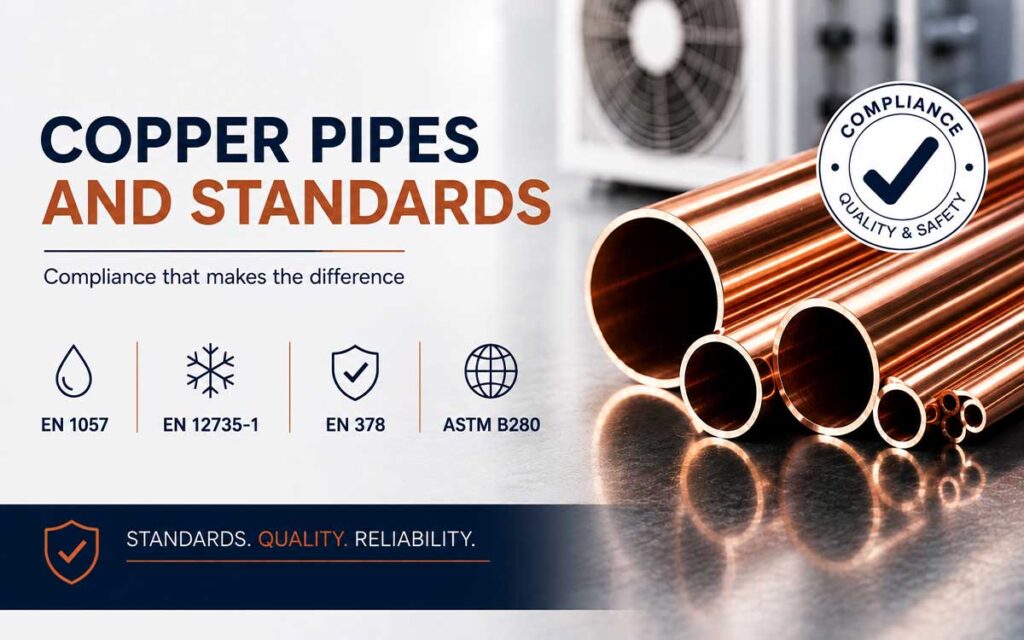
In the HVAC and plumbing industry, talking about copper pipes also means talking about standards. They are not just technical requirements, but essential tools for ensuring safety, reliability, and long-term performance. Standards define precise parameters—including dimensions, wall thickness, material quality, and operating conditions—helping to reduce design and installation errors.
Key reference standards
EN 1057 applies to copper tubes used in hot and cold water distribution systems, including drinking water systems, as well as in heating and gas applications. The standard specifies requirements for dimensions, mechanical properties and conditions of supply. When used for drinking water, the tubes must also comply with the applicable national requirements for materials intended to come into contact with water for human consumption.
EN 12735-1, on the other hand, specifically applies to seamless copper tubes intended for refrigeration and air-conditioning systems. It establishes requirements for tube characteristics and internal cleanliness, which is particularly important in refrigeration circuits to ensure the proper operation and reliability of the system.
Alongside this, EN 378 is the European standard that defines safety and environmental requirements for refrigeration systems and heat pumps. EN 378 covers the system as a whole and works in conjunction with the specific technical standards applicable to the various components used in the system.
For applications intended for international markets, it is also important to be familiar with ASTM B280, the U.S. standard for seamless copper tubes used in air-conditioning and refrigeration systems. The standard specifies requirements for the material, dimensional and mechanical properties, and tube cleanliness.
Alongside these standards, additional technical standards and national regulations complete the regulatory framework, establishing specific requirements depending on the type of system, its intended use, and the country in which the product is installed.
Compliance also affects the Declaration of Conformity
In air-conditioning and refrigeration systems, EN 378 is one of the main reference standards for safety in design and installation, while EN 12735-1 defines the requirements for copper tubes used in refrigeration circuits.
The use of products that comply with the applicable standards therefore helps ensure the safety, reliability and proper installation of the system, while also facilitating the issuance of the Declaration of Conformity (Di.Co.), as required by Italian Ministerial Decree No. 37/2008.
Beyond standards: the importance of insulation and outer coatings
Standards define the characteristics of the copper tube itself, but they do not always address its external protection.
In real-world applications, factors such as UV exposure, weather conditions, moisture, condensation, and mechanical stress can significantly affect the durability of the installation. For this reason, in addition to selecting compliant copper tubes, it is essential to choose insulation and outer coatings suitable for the specific application, helping protect the system and preserve its performance over time.
Compliance is the starting point. Protection is what makes the difference. Discover Nuova Zecchini solutions designed to ensure performance, reliability, and long-lasting durability for your HVAC systems. info@nuovazecchini.it